Friday, October 17, 2008

Canadian consumer confidence hits lowest level in 26 years

Globe and Mail UpdateConsumer confidence is sagging in Canada

Canadian consumer confidence plunged to its lowest level in 26 years this month, the Conference Board of Canada said Friday, adding to a string of ever more gloomy readings on the popular mood in the midst of the global financial meltdown.

The index dropped by 11.9 points to 73.9, after climbing for three months in a row, the Ottawa-based organization said in a news release.

The gloomy tune is just as evident in the United States: the University of Michigan consumer sentiment index fell to 57.5 points for October from 70.3 per cent in September, the largest monthly drop yet and well below the 65.0 level forecast by economists.

The Conference Board findings are based on a survey of 2,000 Canadians, conducted between Oct. 2 and Oct. 8.

“The global credit crunch and major stock market declines clearly had an effect on consumer confidence in October,” Pedro Antunes, the board's director of national and provincial forecasting, said in the release. “In addition, consumers felt that they would be worse off in six months, indicating concerns that the financial crisis would not be resolved quickly.”

The board's consumer confidence index has not plumbed these depths since the third quarter of 1982, when Canada was mired in a recession.

A growing number of economists, including those at Bank of Montreal, Bank of Nova Scotia and the University of Toronto are now predicting that Canada is again headed for recession, along with the United States.

However, the board is not among them. Its chief economist Paul Darby forecast Wednesday that although the country faces tough challenges, especially because of falling exports, it will avoid recession, which is technically defined as two consecutive quarters in which the economy contracts.

As for the October consumer confidence readings, the board also said that there have been “indications” over the past couple of days that global credit markets are beginning to loosen – although it could take months before lending conditions return to normal.

Spokesman Brent Dowdall said this was a reference to “marginal” improvements in interbank lending rates.

The survey showed that all the index's components decline.

“Respondents said it was not a good time to make a major purchase and their view about their current and future financial situations also deteriorated,” the board said.

As well, consumers were less optimistic about future employment prospects for the fifth time in six months, and the October decline was the largest this year.

Ontarians' view of the economic universe took the biggest hit, with the confidence index plunging more than ever before, to 67.9 points from 94.5 in September.

In Quebec, it lost 10.2 points, marking the seventh dip in 8 months, while in British Columbia, the index fell British Columbia tumbled by 12.5.

The reading for the Prairie provinces dropped by 6.1 points while that for the Atlantic provinces was least hard hit, falling 4.9 percentage point, the board said.

Bush defends bailout

President explains intervention in financial system as necessary to prevent a wider crisis.

bush_101708_speech.ap.03.jpg

NEW YORK (CNNMoney.com) -- President Bush on Friday d

efended recent federal intervention in the financial system as necessary to ward off a wider economic crisis and said the actions were not just a Wall Street bailout.

"People look at the crisis and say, 'Oh, it's only Wall Street,' " said Bush, addressing the U.S. Chamber of Commerce. "I don't think so. In fact, I know that if we had not acted, it would have affected the American people directly."

"If the government had not acted, the hole in our financial system would have gotten larger," he added.

Bush's comments - his 34th public statement on the economic crisis since the collapse of Lehman Brothers in mid-September - came just minutes after the Commerce Department reported that initial construction of U.S. homes fell to a fresh 17-year low in September. Housing starts fell to 817,000 residential units, down 6.3% from 872,000 housing starts the prior month.

Wall Street got off to another rough start on Friday, with the Dow falling more than 200 points. Stock prices have been highly volatile. This week alone, the Dow Jones had its second biggest daily point gain and second biggest drop ever.

Of the many recent measures that the U.S. government has taken to address the ongoing economic crisis - and the credit freeze in particular - the most sweeping is the $700 billion in newly approved funding that will be used, in part, to invest in banks and buy bad mortgage assets. The aim is to free up the major banks to lend once again.

Bush said the government would limit its intervention in size and scope, and did not intend to nationalize the banking system. "The government intervention is not a government takeover," he said.

Nevertheless, the government has taken a 79.9% stake in battered insurance giant American International Group (AIG, Fortune 500), in exchange for its initial $85 billion credit line granted on Sept. 16. On Oct. 8, the Federal Reserve extended an additional credit line of $37.8 billion to the company, for a total of $122.8 billion. So far, AIG has tapped $82.9 billion of the emergency funding.

The first big government intervention occurred on Sept. 7, when Treasury Secretary Henry Paulson and James Lockhart, director of the Federal Housing Finance Agency, extended as much as $200 billion to save Fannie Mae (FNM, Fortune 500) and Freddie Mac (FRE, Fortune 500).

This action, essentially a taxpayer-funded government takeover, was intended to prevent the collapse of these spiraling mortgage giants, which own or back more than $5 trillion worth of mortgage debt, or about half the mortgage debt in the country. To top of page

Buffett: I'm buying stocks

Berkshire Hathaway CEO gives advice on how to invest during America's money crisis in a New York Times op-ed.

Buffett: Our system works

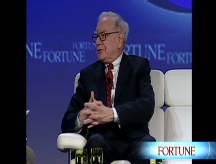
NEW YORK (CNNMoney.com) -- Billionaire investor Warren Buffett used a guest commentary article in the New York Times on Friday to announce that he's sticking with stocks.

Buffett, the so-called Oracle of Omaha for his ability to buy up the right companies at the right time for his holding company Berkshire Hathaway (BRK.A), said the worst may not be over for the faltering economy.

"In the near term, unemployment will rise, business activity will falter and headlines will continue to be scary," Buffett wrote.

But for that reason, the Berkshire CEO said, he has converted his personal portfolio almost entirely to U.S. stocks. Previously, he said he owned nothing but Treasury bonds.

Buffett said the fear surrounding the disastrous credit crisis, which has dropped stocks about 36% from their all-time highs set around this time last year, has left equities with attractive purchasing prices.

"A simple rule dictates my buying: Be fearful when others are greedy, and be greedy when others are fearful," said Buffett. "And most certainly, fear is now widespread, gripping even seasoned investors."

Stock prices have been volatile, to say the least. Consider what happened this week alone: The Dow Jones gained 976 points on Monday; fell 76 points on Tuesday; dropped 733 points on Wednesday and then gained 401 points Thursday. But Buffett says the future is much brighter for stocks.

"Fears regarding the long-term prosperity of the nation's many sound companies make no sense," wrote Buffett. "Most major companies will be setting new profit records 5, 10 and 20 years from now."

Still, many nervous investors have been ditching the up-and-down stock market and pouring their funds into physical assets like gold or cash equivalents. Though they may feel safe now, Buffett said those investors are holding "terrible long-term assets" that will not come close to matching the future gains of stocks.

"The hapless ones bought stocks only when they felt comfort in doing so and then proceeded to sell when the headlines made them queasy," Buffett added.

So if strong companies are destined for long-term success, bad news is good news when you're looking to invest in the stock market.

"Bad news is an investor's best friend," Buffett said. "It lets you buy a slice of America's future at a marked-down price." To top of page